
For In-House SEO Teams
Deeper page optimization for internal SEO and content teams
ScriZen SEO Page Auditor helps in-house teams move beyond vague content scoring and into structured, execution-ready work based on deep mathematical page analysis, clearer internal handoff, and stronger control over daily SEO operations.
Clearer execution across SEO and content workflows
Built for teams that need better page-level diagnostics, smoother analyst-to-writer execution, and a workflow that remains predictable as audit volume grows.

From deeper analysis to clearer execution
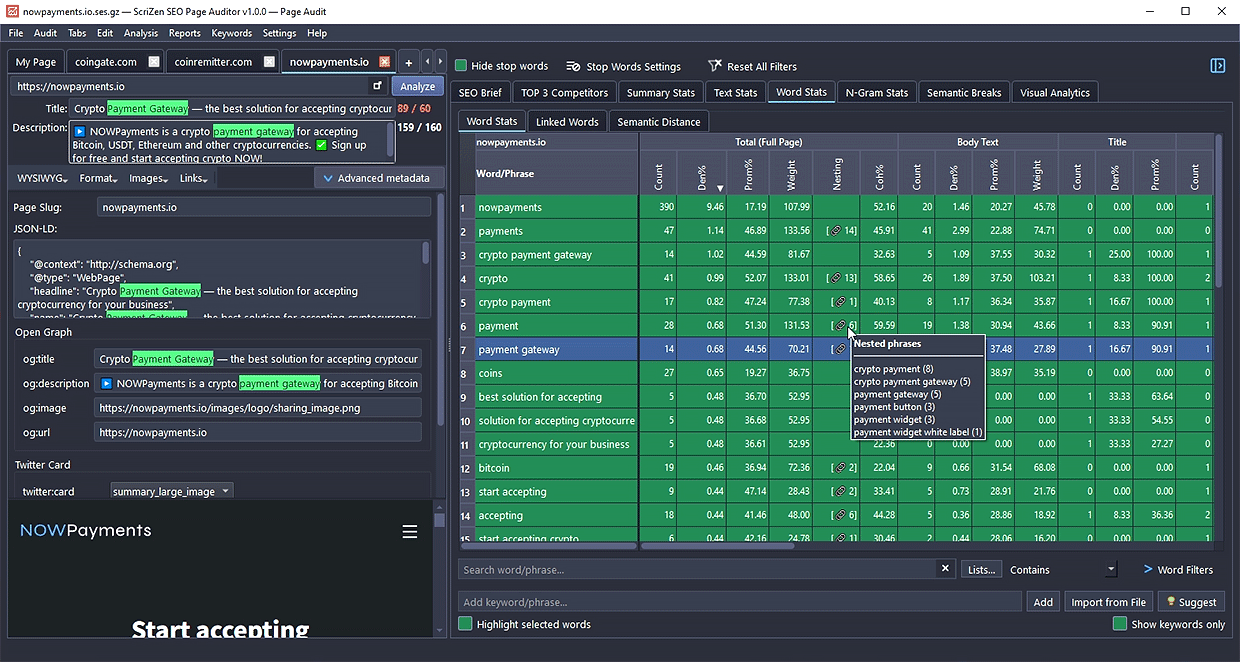
SEO Page Auditor turns selected competitor pages into a clearer analytical workspace for inspecting page-level evidence, comparing patterns, and generating execution-ready tasks.
Page-level evidence
Structured diagnostics
Execution-ready tasks
A more mature way to move from analysis
to execution inside the department
Internal teams often do not struggle because they have no data. They struggle because the data is too shallow to be useful, too dense to hand off cleanly, or too unpredictable operationally to support steady production.
01
Deeper analysis than generic content scoring
Basic content scores rarely show the real page-level gaps that matter during refreshes, benchmark work, or internal quality review. This approach gives teams a deeper analytical foundation to work from.
02
Better alignment between SEO strategy and content execution
SEO specialists and content teams do not need the same view of the work. ScriZen separates analytical complexity from execution clarity so each side can move faster with less interpretation overhead.
03
A more predictable internal workflow
Secure, repeatable analysis and steadier recurring economics make the tool easier to adopt inside a real department where throughput, coordination, and planning all matter.
Let the right people see
the right layer of information
The goal is not to expose every internal stakeholder to the full analytical surface. The goal is to preserve depth for SEO leads while making execution clearer for writers, editors, and other non-specialist collaborators.
Review deeper metrics, structural weaknesses, and strategic opportunities
SEO leads can use the deeper layer to assess page-level gaps, review structural weaknesses, and identify strategic opportunities before content execution begins. This makes it easier to validate direction, reduce guesswork, and refine technical tasks around campaign priorities.
- Assess meaningful page-level gaps with more analytical depth
- Inspect structural issues that lighter tools flatten into generic scoring
- Adjust technical tasks to fit internal campaign priorities and workflows
Execute from clearer briefs instead
of parsing raw analytical tables
Writers and editors should not need to behave like technical SEO specialists in order to produce stronger pages. They receive a clearer execution layer that reduces friction during handoff and improves consistency across content production.
- Reduce confusion during analyst-to-writer handoff
- Minimize dependency on manually translated audit notes
- Support more consistent updates, rewrites, and internal QA
Designed for real internal production,
not just isolated one-off audits
In-house teams need software that supports recurring work across multiple stakeholders, not just a dashboard that looks impressive during a single review session. The value comes from how well the product fits the daily rhythm of planning, analysis, editing, and execution.
Content refresh workflows
Use deeper diagnostics to prioritize existing pages, guide update cycles, and improve how the team decides what deserves attention first.
Competitor benchmark analysis
Compare selected competitors and turn those findings into more concrete internal tasks rather than vague benchmarking notes that stall after the review.
Internal content QA
Support editors and SEO leads with a stronger analytical basis for checking whether planned or drafted pages meet structural and semantic requirements before publication.
Faster analyst-to-writer handoff
Make it easier to move from deeper audit work into production-ready assignments without adding unnecessary manual interpretation in the middle.
Keep recurring software overhead
easier to plan as workload increases
Budget friction becomes a real operational problem when analysis volume grows faster than software predictability. Internal teams need a setup they can explain, plan, and scale without unnecessary volatility in recurring use.
Bypass the restrictive monthly cloud-credit model
SEO Page Auditor gives internal teams a steadier operational framework by reducing dependency on usage patterns that can distort budget planning or interrupt analysis momentum mid-cycle.
- Avoid mid-month friction caused by fluctuating cloud-credit needs
- Plan audit volume with more confidence during active production periods
- Make recurring software overhead easier to explain internally
More control over recurring software overhead
As audit frequency, benchmark work, and content production cadence increase, the tool remains easier to position as a practical departmental asset rather than a variable-cost workflow risk.
- Scale internal usage more comfortably across teams and workflows
- Reduce the perception of analysis as a variable-cost operational risk
- Reinforce the tool’s role as a stable part of the department’s workflow stack
Frequently Asked Questions
Can't find what you're looking for?
Check out our full documentation.
1. Do our content writers need to be technical SEO experts?
Not at all. We designed the workflow specifically to bridge the operational alignment between SEO strategy and content execution. Your SEO lead handles the deep diagnostics, while your content team receives execution-ready SEO briefs – eliminating the need for them to interpret raw analytical tables.
2. Will we need to request more budget for cloud credits mid-month?
No. SEO Page Auditor completely bypasses the restrictive monthly cloud-credit model. Your licensing is predictable, giving your department full control over recurring software overhead regardless of your audit volume.
3. Why does SEO Page Auditor use live SERP parsing instead of relying on prebuilt SEO databases?
Many SEO platforms suffer from stale databases: they show a competitive picture as it existed a week, or even a month, earlier. Real-time parsing — Live SERP Analysis — is the only way to work with the current, undistorted competitive picture, especially when search algorithms are volatile.
In SEO Page Auditor, this parsing and computation happen natively, outside the normal limitations of cloud SaaS workflows. That gives the application much more operational flexibility. The program moves through the selected URL list, captures the current content structure here and now, builds a term matrix, and immediately runs that matrix through mathematical competitor-analysis formulas.
This is the practical meaning of a data-driven approach to creating SEO briefs: the brief is derived from live page evidence, not from an outdated database snapshot.
4. Can we use this for our internal content QA process?
Yes. The tool provides a clear analytical foundation. Editors and SEO leads can use it to enhance internal content QA standards and validate whether a drafted page meets structural and semantic requirements before it goes live.
5. How does ScriZen replace the manual work of a Senior specialist?
By acting as a virtual Senior SEO specialist, the program automatically performs complex mathematical analytics on top-ranking competitors. This completely eliminates manual data collection, transforming deep audit results into automated technical tasks.
6. How does SEO Page Auditor use page-zone mathematics to turn competitor data into SEO briefs?
SEO Page Auditor is built on a foundational mathematical approach to competitive SEO analysis. The parser collects data for every term — for example, “bitcoin” or “crypto” — and stores it as a structured matrix. For each specific phrase, the system calculates not only the absolute number of occurrences, or Count, but also more advanced technical metrics: density (Den%), prominence (Prom%), and weight. More importantly, these calculations are not blended into a single generic score. They are isolated by page zone, from Title and H1 to Body Text, the Intro section — the first 150 words — and metadata.
This structure maps directly to ScriZen’s task-generation logic:
- The benchmark core: the application collects raw, real-world data from competitor pages.
- Automated SEO brief creation: ScriZen’s algorithm can use the averaged competitor text-volume indicators to define baseline variables for a technical task.
- Intelligent filtering: the cascading formula takes the full collected term set, applies quotas across Strategic, Structural, and LSI zones, and automatically cuts off the noisy long-tail residue.
This level of granularity — including nesting and proximity indices — gives a native desktop application a serious computational advantage over browser-based SaaS tools. Most browser-based tools reduce the page to a generic average keyword-density or over-optimization signal. SEO Page Auditor can evaluate the structural weight of each zone instead of treating the page as one flat block of text.
7. Can our SEO lead modify the automatically generated tasks?
Absolutely. Senior SEO specialists can use the deep analysis results to validate their internal strategies or easily adjust the automated technical tasks to fit the specific needs of the company’s in-house campaigns.
8. What is the advantage of an automated technical task over standard advice?
Standard advice often requires interpretation by a strategist. ScriZen removes this bottleneck. Because it conducts a mathematically precise page audit, it provides concrete, automated technical tasks. Writers know exactly what to execute, effectively removing the Senior SEO’s heavy lifting at the planning stage.
Built to bridge the gap between SEO strategy and content execution
Stop letting complex analytical reports slow down your writing team. Start your 7-day trial and experience a frictionless, predictable workflow without cloud-based usage limits.